


Navigating Anger After Injustice: The STORM Approach
Recently, many of us have been grappling with profound grief and intense anger about the senseless murders of Austin Metcalf and Henry Novak. When staggering injustices like this occur, it is completely normal to feel a welling up of rage. As a clinical psychologist, I want to validate that feeling: your anger is not something to be ashamed of or something you need to immediately push away.
In fact, the healthy function of anger is to signal that a profound boundary has been violated. It is an evolutionary tool designed to energize us to strengthen, protect, and set boundaries.
However, sitting in raw anger without an outlet can take a toll on our mental and physical well-being. We need a healthy way to process it through boundary-setting action. That is why I developed the STORM approach—to help channel that fiery, protective energy into something constructive and healing.
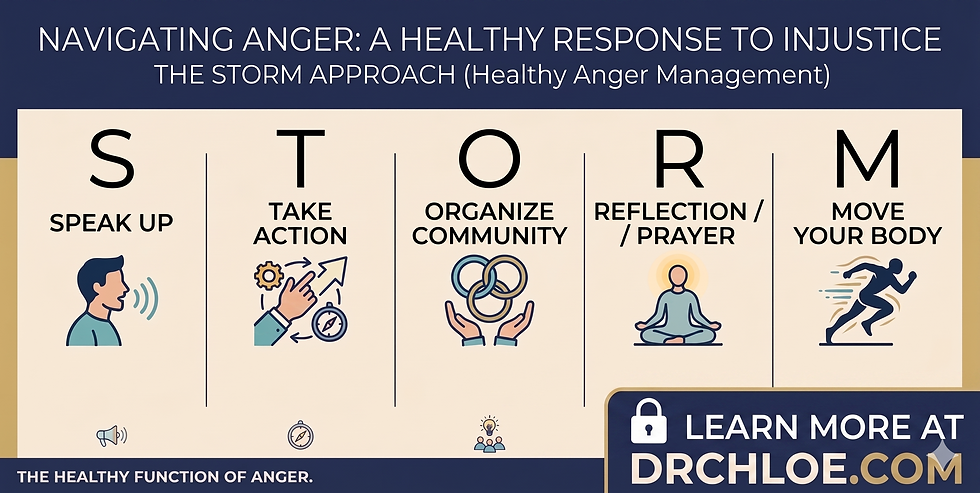
When you are feeling overwhelmed by righteous anger, remember to weather the STORM:
S - Speak up: Give voice to your feelings. Communicate your boundaries and your stance clearly and firmly.
T - Take action: Helplessness fuels despair. Make a plan and execute the next right step, no matter how small it may seem. Action is the antidote to despair.
O - Organize community: You do not have to carry this heavy burden alone. Connect with others who share your values to process the grief and address the injustice collectively.
R - Reflection / Prayer: Take quiet moments to connect with your inner self. Processing your emotions internally helps you find grounding, seek guidance, and maintain perspective.
M - Move your body: Anger is a highly physiological emotion; it lives in the body. We often need vigorous exercise when dealing with intense anger to release that pent-up physical tension. Go for a run, hit a punching bag, or do a high-intensity workout.
Expressing our true feelings in the face of societal tragedies can sometimes feel daunting. We might worry about saying the "wrong" thing, facing backlash, or disrupting the peace, which can quickly lead to self-censorship. I explore this dynamic deeply in my book, Can I Say That? Why Free Speech Matters and How to Use It Fearlessly. When we suppress our authentic reactions to injustice out of fear, we deny ourselves the healthy, boundary-setting function that our anger is trying to provide. Speaking freely about what matters to us is essential for our psychological health.
If you are feeling overwhelmed by the news right now, please remember to give yourself grace. Lean on your community, move your body, and do not be afraid to speak up. Your voice—and your healthy anger—are vital tools for processing injustice and creating a stronger, safer world.


